About
AstroPunk Observatory is a set of virtual private remote telescopes. Remote operations are managed by our in-house software (lazyObs & lazyPhot). lazyObs collects data during the observing session and synchronizes it to a server, where the FITS files are automatically processed with Munipack. The processed data are available in transformed form for download and analysis a few hours after the session. Using plans, you can schedule object frames, darks or flats (the scopes move during evening/morning twilight to take sky flats) without ever touching the remote PC. The web interface is all you need. You can also connect to the PCs directly and operate them manually.
We use Munipack, PixInsight and RC Astro plugins to squeeze astrophotos out of our frames. We use old components, second-hand equipment and home-made stuff, so we call it astroPunk. So far we operate five different imaging trains, and a sixth is on its way. This one is the final BOSS. More is coming in 2026/2027. The dream will come true. We collaborate with Masaryk University on 2+2 quadruple systems of eclipsing binaries (Squadra project) and with Charles University on imaging Be stars (deep stacks and photometry), and we take part in transient campaigns. Over the last 30 years we have obtained data for CBA, VSNET and AAVSO. We hope to continue with all of this, and much more, in the future with our BOSS. Some AGNs? Mergers? Who knows...
There are around 12 of us involved in all this, and we all love astronomy and the night sky. And computers. And LLMs. And dogs. And cats... And stuff...
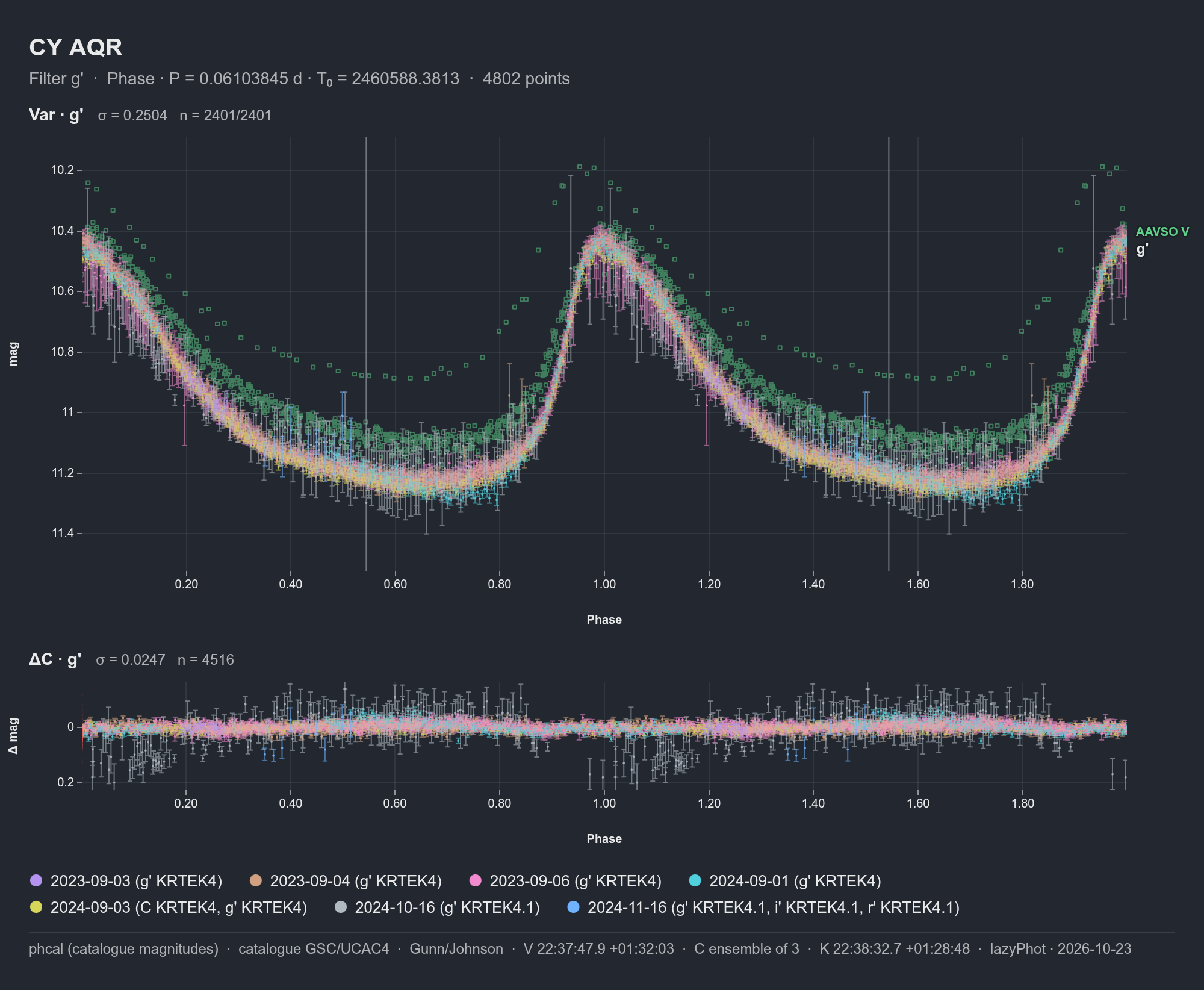 CY Aqr: Krtek4 photometry in the C filter compared with AAVSO V-band data.© astropunk.cz
Observation results
Papers, circulars and conference contributions that include our photometric and astrometric observations of variable stars, novae, gamma‑ray bursts and other objects.
2026
Observational study of double superoutbursts in long-orbital-period AM CVn stars
2018
Possible substellar companions in low-mass eclipsing binaries: GU Bootis and YY Geminorum
2016
A Very Bright, Very Hot, and Very Long Flaring Event from the M Dwarf Binary System DG CVn
Superoutburst of CR Bootis: Estimation of mass ratio of a typical AM CVn star by stage A superhumps
2015
Survey of period variations of superhumps in SU UMa-type dwarf novae. VII. The seventh year (2014–2015)
2014
Survey of period variations of superhumps in SU UMa-type dwarf novae. VI. The sixth year (2013–2014)
Superoutburst of SDSS J090221.35+381941.9: First measurement of mass ratio in an AM CVn-type object using growing superhumps
2011
SDSS J162520.29+120308.7 – a new SU Ursae Majoris star in the period gap
2010
Survey of Period Variations of Superhumps in SU UMa-Type Dwarf Novae. II. The Second Year (2009–2010)
2009
Survey of Period Variations of Superhumps in SU UMa-Type Dwarf Novae
Photometry of Three Superoutbursts of the SU UMa-Type Dwarf Nova, SW Ursae Majoris
2008
A new activity phase of the blazar 3C 454.3. Multifrequency observations by the WEBT and XMM-Newton in 2007–2008
GRB 080430: Optical observation in AsU CAS Ondřejov & Brno
GRB 080319B: Optical observation (Brno, CZ)
2006
Deductions from the Indication of Eclipses of Nova V1493 Aql
The possible orbital period of the nova V1493 Aquilae
2005
2004
V1493 Aql: an extremely distant nova?
A New SU UMa-Type Dwarf Nova, QW Serpentis (= TmzV46)
2003
Superhumps in Cataclysmic Binaries. XXIV. Twenty More Dwarf Novae
2002
The 2001 Superoutburst of WZ Sagittae
Optical Observations of XTE J1118+480 during the 2000 Outburst
Kilo-Second Quasi-Periodic Oscillations in the Cataclysmic Variable DW Cancri
First detection of the growing humps at the rapidly rising stage of dwarf novae AL Com and WZ Sge
2001
Discovery of a New ER UMa-Type Dwarf Nova IX Draconis
Detailed optical behavior of the 2000 outburst of the eclipsing recurrent nova CI Aquilae
The 2000–2001 Superoutburst of the WZ Sge-Type Star RZ Leonis: A Clue to Understanding the Origin of Viscosity in Quiescent Dwarf Nova Disks
V1494 Aquilae
The 1997 Superoutburst of the SU UMa-type Dwarf Nova V2176 Cygni
A normal and superoutburst study of the eclipsing SU UMa star: DV Ursae Majoris
2000
V1494 Aquilae
A newly discovered SU UMa-type dwarf nova, HS 1449+6415
CCD Photometry of the May 2000 Outburst of the Cataclysmic Variable RXJ 1450.5+6403
V1494 Aquilae
V1493 Aquilae
XTE J1118+480
Discovery of a New Deeply Eclipsing SU UMa-Type Dwarf Nova, IY UMa (= TmzV 85)
Cataclysmic Variable in Ursa Major
1999
CCD Photometry of the 1999 February Superoutburst of CT Hya
1998
CCD Photometry of SW Ursae Majoris during the 1996 Superoutburst
Two Galactic Supersoft X-Ray Binaries: V Sagittae and T Pyxidis
CCD Photometry of Two Variable Stars in M 27 Field
1997
Revealing of a New SU UMa Type Variable Star Var21 Coronae Borealis
1996
Comet C/1996 B2 (Hyakutake)
International TOAD Watch – GAMA
DOI links to the paper at the publisher, ADS to the record in the NASA Astrophysics Data System, arXiv to the freely available preprint. Only the first author is shown; the full author list is on the publisher's page.